
Artificial intelligence is no longer a future concept. It’s already shaping how companies operate and how consumers live. From recommendation engines and logistics software to chatbots and automation tools, AI is becoming a major driver of growth across tech, healthcare, finance, and other industries.
AI exchange-traded funds (ETFs) offer a simple way to invest in that growth without relying on a single stock. Rather than trying to pick individual winners, these funds group together companies that build AI technology or benefit from its adoption. That can include chipmakers, cloud platforms, software firms, and data-focused businesses.
Interest in AI investing remains strong as generative AI tools like ChatGPT push adoption into the mainstream. For investors who want diversified exposure to AI’s long-term potential without the risk and research involved in picking individual stocks, the best AI ETFs can be a smart place to start.
ALSO READ: Top 7 AI Math Tools to Solve Complex Math Problems 2026
Top AI ETFs to buy in 2026
1. Global X Artificial Intelligence and Technology ETF
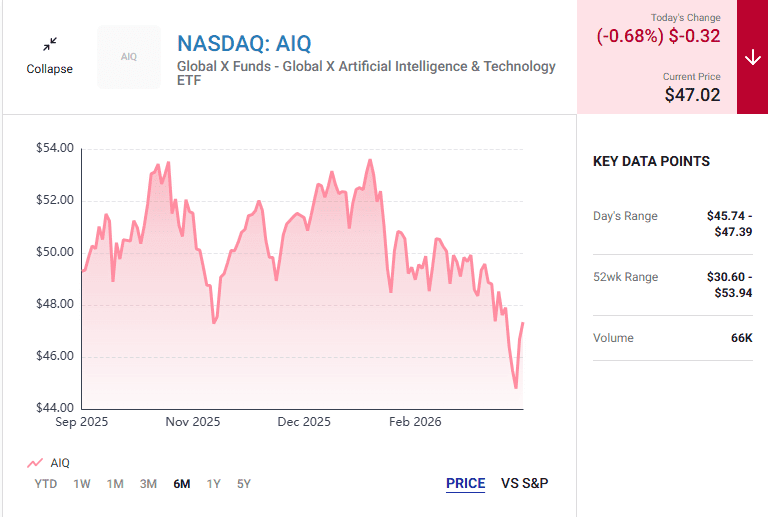
Global X Artificial Intelligence and Technology ETF (AIQ -0.63%) is the largest AI ETF and a good first choice for investors looking for an AI ETF. The ETF started in 2018 and aims to invest in companies that can benefit from the development of AI technology, as well as companies that make hardware facilitating the use of AI.
According to Global X, the global AI market is expected to grow from $184 billion in 2024 to $826.7 billion in 2030, suggesting the stocks in the fund should have a lot of growth in front of them. The ETF has 85 stocks, and the biggest holdings will be familiar to most investors. In 2026, the top 10 holdings accounted for about 33% of the fund. Here are the top five:
- Samsung (OTC:SSNL.F): The Korean tech giant is the world’s No. 2 chipmaker and is well-known for devices like smartphones. It has introduced AI features such as live translate and chat assist to help users write messages.
- SK Hynix: Leading memory-chip maker from South Korea and a key supplier of high-bandwidth memory to companies like Nvidia.
- Netflix: The leading video streamer and a global entertainment powerhouse.
- Cisco Systems: A global leader in networking hardware, software, and telecommunications equipment, is integrating AI across its infrastructure.
- Apple: Tech giant best known for its smartphones and devices like the iPhone, iPad, and Mac.
- Taiwan Semiconductor: The world’s largest manufacturer of semiconductors, serving customers like Nvidia, Broadcom, AMD, Apple, and others.
Cloud Computing
Cloud computing is a network of interconnected servers and data centers working together to deliver a service through the Internet.
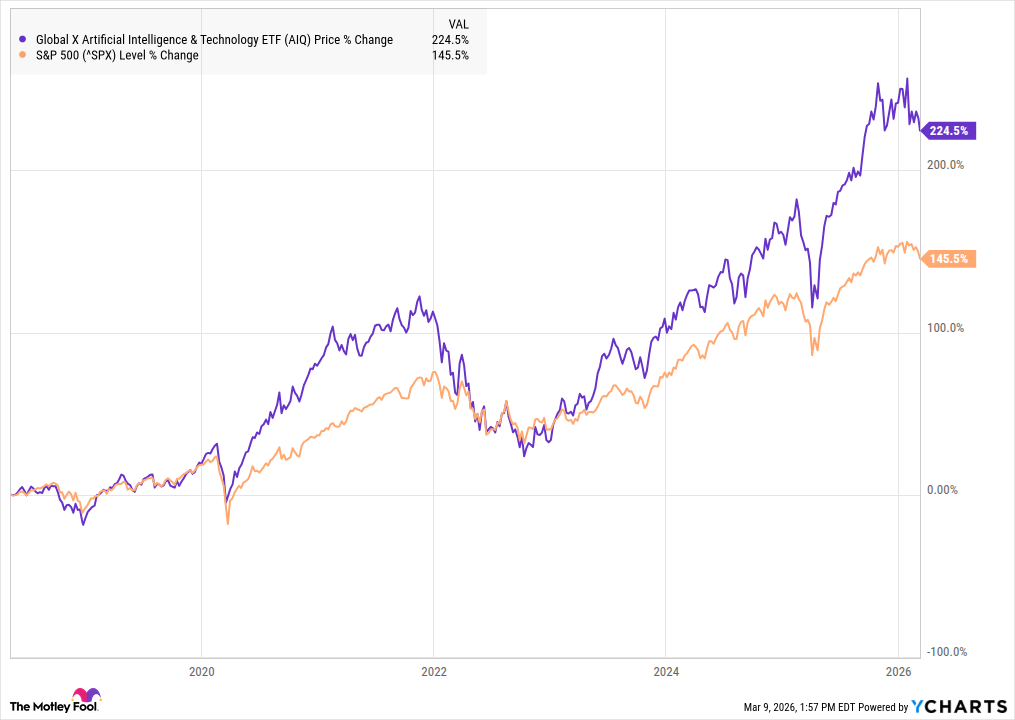
As you can see from the chart below, the Global X ETF has outperformed over its history, thanks in part to the recent surge in memory chip stocks like SK Hynix and Samsung.
2. Global X Robotics and Artificial Intelligence ETF

Established in 2016, the Global X Robotics and Artificial Intelligence ETF (BOTZ -1.70%) is similar to the Global X Artificial Intelligence and Technology ETF but with a focus on robotics. The fund invests in “companies that potentially stand to benefit from increased adoption and utilization of robotics and artificial intelligence.”
This includes enterprises working in industrial robotics, automation, non-industrial robots, and autonomous vehicles. According to Global X, the global robotics market was valued at more than $80 billion in 2022 and could grow to $280 billion by 2032.
The ETF held 50 stocks in early 2026, and its top five holdings made up almost 40% of the fund:
- Nvidia (NVDA +0.49%): This semiconductor maker’s chips are used in a wide variety of applications — including autonomous vehicles, virtual computing, and cryptocurrency mining — and are central to many AI technologies.
- ABB (OTC:ABBN.Y): This Swiss company makes industrial automation and robotics products used in utilities and infrastructure.
- FANUC (FANUY -3.76%): This Japanese maker of factory automation products includes motors, lasers, and robots in its product lineup.
- Keyence (KYCCF +0.11%): This Japanese company makes factory automation products such as sensors and scanners.
- Intuitive Surgical (ISRG -2.15%): This company makes the da Vinci robotic surgical system, which allows for minimally invasive surgeries with precise control.
As the chart below shows, shares of the ETF have underperformed the S&P 500 index since its 2016 launch. The share price fell sharply in 2022 in line with the broad sell-off in tech stocks, although it has rebounded since then.
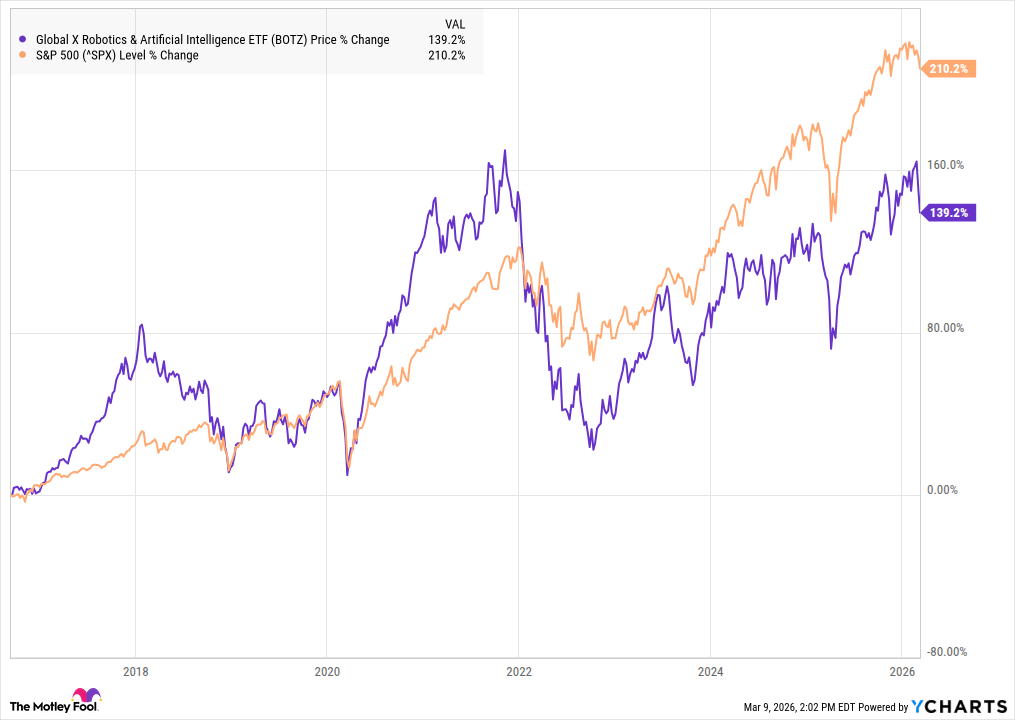
The ETF offered a modest dividend yield of 0.63% in Feb. 2026, but it is better suited as a growth-oriented investment. It’s an actively managed fund with an expense ratio of 0.68%, which is more than what you’d pay for most index funds.
3. Robo Global Robotics and Automation Index ETF

The Robo Global Robotics and Automation Index ETF (ROBO -1.34%) focuses on companies driving “transformative innovations in robotics, automation, and artificial intelligence.” This ETF invests in companies primarily focused on AI, cloud computing, and other technology companies.
The ETF holds 77 stocks, with no single holding accounting for more than 2.5% of the ETF’s value. Its top five holdings comprise only about 10% of the fund’s total value. In early 2026, major holdings included:
- Teradyne (TER -2.39%): A maker of automated test equipment and robotics systems for applications such as testing semiconductors and other hardware.
- Koh Young Technology: A leading developer of AI-powered 3D measurement and inspection technology used in electronics manufacturing.
- Airtac International: A global manufacturer of pneumatic equipment and industrial automation components, serving industries like automotive, electronics, and aerospace.
- Novanta: A maker of components for surgical robots, minimally invasive surgery, and laser technology.
- IPG Photonics: A maker of high-performance fiber lasers used to cut, weld, and drill materials for industries like automotive manufacturing.
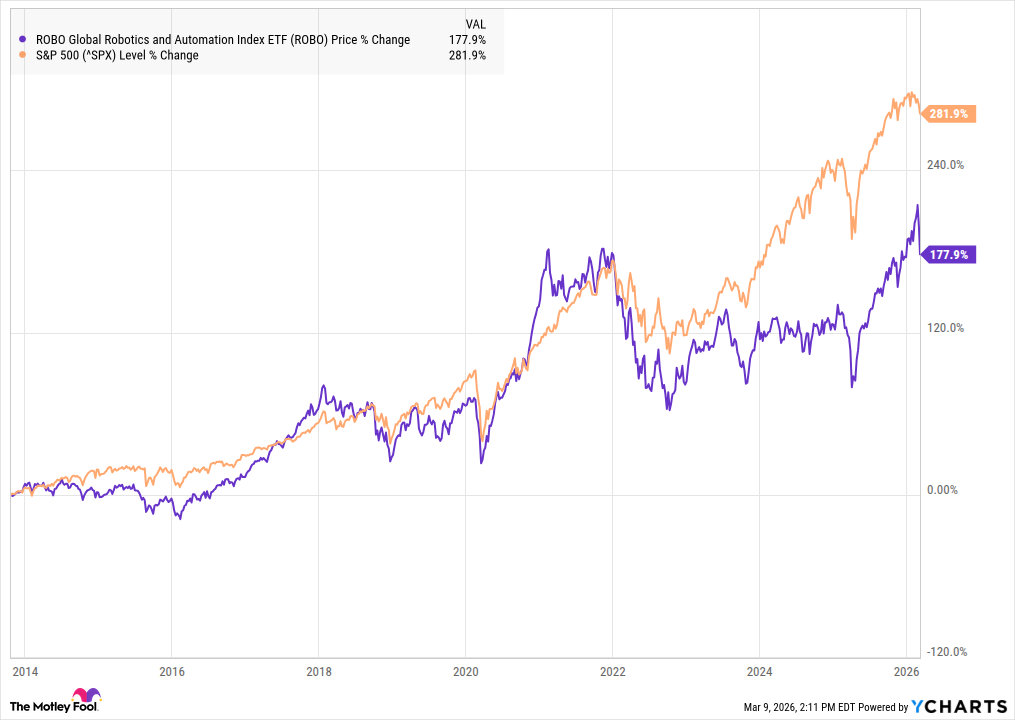
Since its inception in 2013, the Robo ETF has underperformed the S&P 500, as the chart below shows. It trails the broad market index, with dividends factored into the return. The ETF pays a dividend yield of 0.4%, and its expense ratio is 0.95%.
4. iShares Future AI and Tech ETF
The iShares Future AI and Tech ETF (ARTY -0.65%) aims to track the results of an index of developed and emerging markets companies that could benefit from long-term opportunities in robotics and AI. The ETF was formed in 2018 and has about $2.1 billion in net assets.
With 49 stock holdings, it’s now well diversified. Many of its top holdings also give investors exposure to fast-growing small-cap companies. The fund’s top five investments as of March 2026 accounted for about 25% of the ETF’s assets and included Nvidia, SK Hynix, and:
- Micron: A leading memory chipmaker, which has benefited from demand for high-bandwidth memory (HBM) chips in the AI boom.
- Taiwan Semiconductor: The world’s largest manufacturer of semiconductors, serving customers like Nvidia, Broadcom, AMD, Apple, and others.
- Marvell Technology: A leading fabless semiconductor maker known for custom AI chips (XPUs), data processing chips (DPUs), and networking components.
As you can see from the chart below, the ETF has underperformed the S&P 500 since its founding. The fund fell in 2022 when tech stocks crashed.
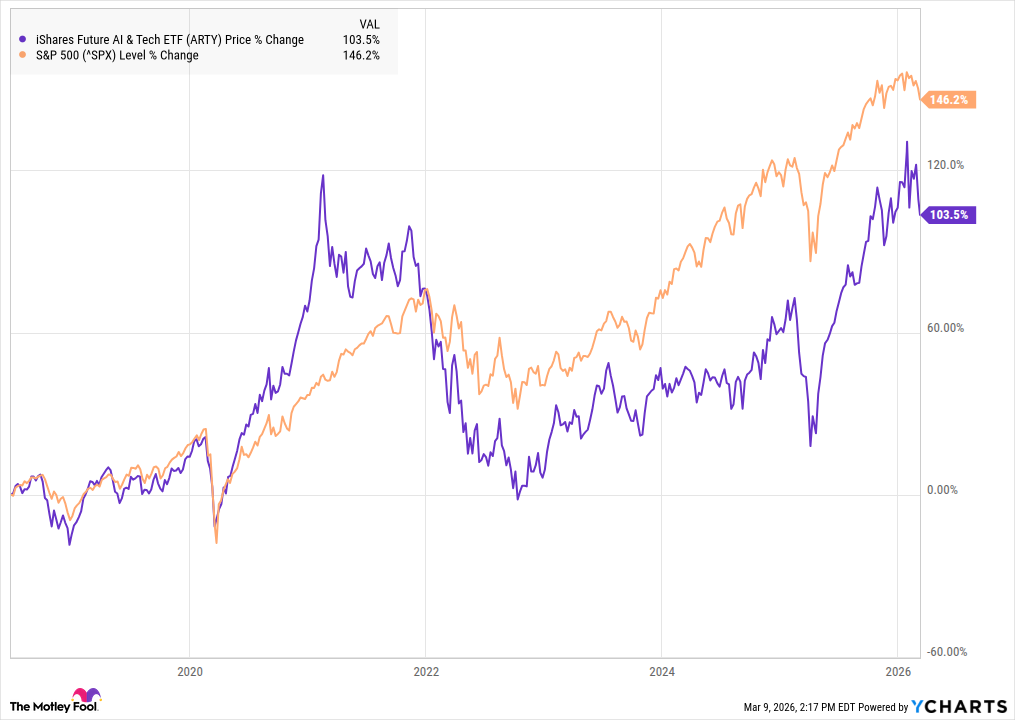
The expense ratio is competitive at 0.47%. The fund’s performance will likely be heavily influenced by the overall performance of cloud and chip stocks, since they’re the fund’s largest areas of exposure.
5. First Trust Nasdaq Artificial Intelligence and Robotics ETF

The First Trust Nasdaq Artificial Intelligence and Robotics ETF (ROBT -0.55%) tracks the Nasdaq CTA Artificial Intelligence and Robotics index, which comprises companies engaged in AI and robotics in technology, industrials, and other sectors. The fund held 110 stocks in early 2026.
Top holdings included Fanuc and four others:
- Oceaneering International: A provider of engineered services and robotic solutions used in the offshore energy, defense, aerospace, and manufacturing industries.
- Ocado Group: A U.K.-based online grocery company. It sells groceries directly online and offers a platform that retailers can use.
- QinetiQ Group: A U.K.-based global defense and security technology company known for testing and evaluation of defense equipment.
- Siemens: A German industrial technology company that calls itself the largest provider of industrial automation with technology for smart buildings, power grids, and transportation.
Types of AI ETFs
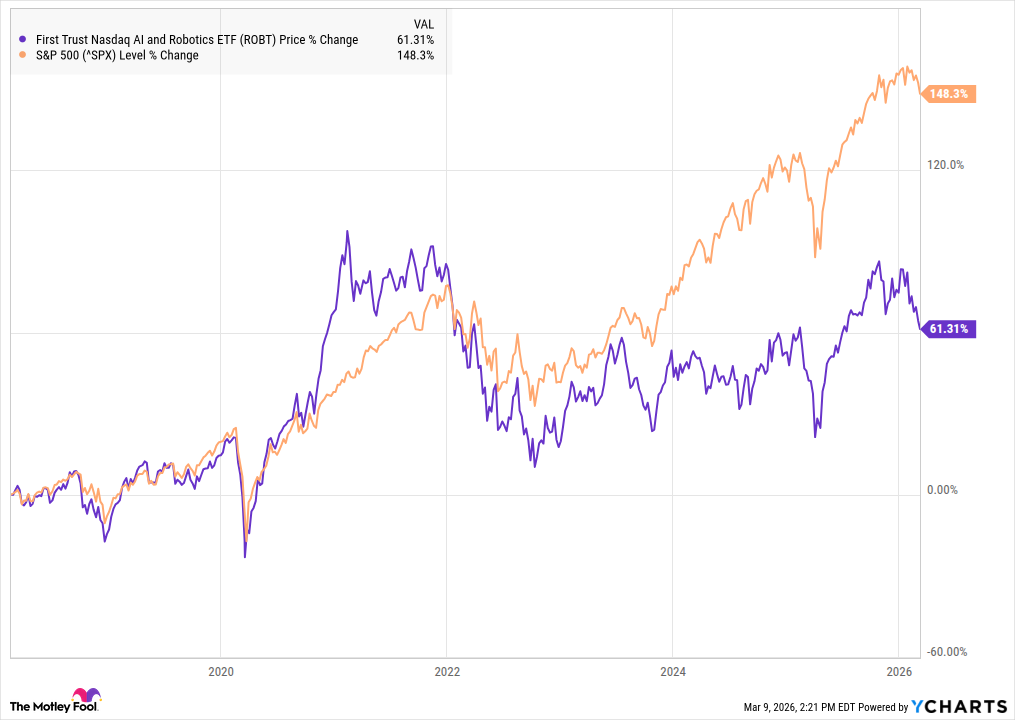
As the chart above shows, there are different types of AI ETFs available to investors. Here are a few of the broad categories.
- Tech-focused AI ETFs: These ETFs are more likely to carry semiconductor stocks and pure tech stocks that are influencing AI.
- Robotics and physical AI: On the other end of the spectrum are companies developing real-world machines that run on AI. Relatedly, there are maintenance, equipment, and testing companies as well.
- Small-cap versus large-cap: Some ETFs focus more on large-cap companies, while others, like First Trust Nasdaq Artificial Intelligence and Robotics ETF, hold a lot of smaller-cap stocks.
- Other options: Investors can also consider related ETFs, such as those that focus on semiconductors or other high-tech applications.
Pros and cons of investing in AI ETFs
Here are some pros and cons of investing in AI ETFs.
Pros:
- They’re an easy way to get exposure to AI stocks.
- They save time and effort compared to buying individual stocks.
- Global X Artificial Intelligence and Technology ETF, the biggest AI ETF, has a track record of outperforming the S&P 500.
- They can give you exposure to lesser-known robotics and international stocks.
- They provide a quick way of diversifying your holdings in artificial intelligence.
- It’s a lower-risk way of getting exposure to a high-growth industry than individual stocks.
- While there is a cost due to the expense ratio, it is lower than some other managed ETFs.
Cons:
- Most AI ETFs have underperformed the S&P 500.
- They tend to be more expensive than other ETFs.
- They have lagged behind high-profile AI stocks like Nvidia.
- High-performing chip stocks aren’t always included in AI ETFs.
How to choose an AI ETF
If you’re thinking of buying an AI ETF, you’ll want to choose the right one for you. Some criteria to help you choose an AI ETF include:
- Past performance: ETFs with a stronger track record are more likely to outperform.
- Top holdings: This can give you a quick sense of where the ETF is allocating its funds.
- Strategy: Some ETFs are actively managed, while others follow an index or an underlying group of stocks.
- Valuation: Some ETFs are cheaper than others.
- Expense ratio: Some ETFs cost more to own than others.
- Dividend yield: A healthy dividend yield can make up for slower growth.
AI ETFs vs. AI mutual funds
Investors looking for an easy way to diversify into AI stocks can also choose from mutual funds like T. Rowe Price Science & Technology Fund (PASTX +4.47%) and Fidelity Select Technology Portfolio (FSPTX +4.99%), which invest in big tech stocks and smaller AI specialists.
However, the same drawbacks that apply to other ETFs apply to these, including that management fees tend to be higher and they’re less liquid, as your trade won’t close until the end of the trading day. Still, if you’re looking for greater exposure to big tech stocks, those mutual funds and others are worth exploring.
Who should invest in AI ETFs?
AI ETFs aren’t right for everybody, but they’re a good fit for some investors. If these descriptions fit your investing style, AI ETFs could work for you.
- You have a high risk tolerance.
- You have a long time horizon.
- You’d prefer one investment over several individual stocks.
- You like the convenience of an ETF compared to individual stocks.
- You’re looking for a wide range of exposure to AI stocks.