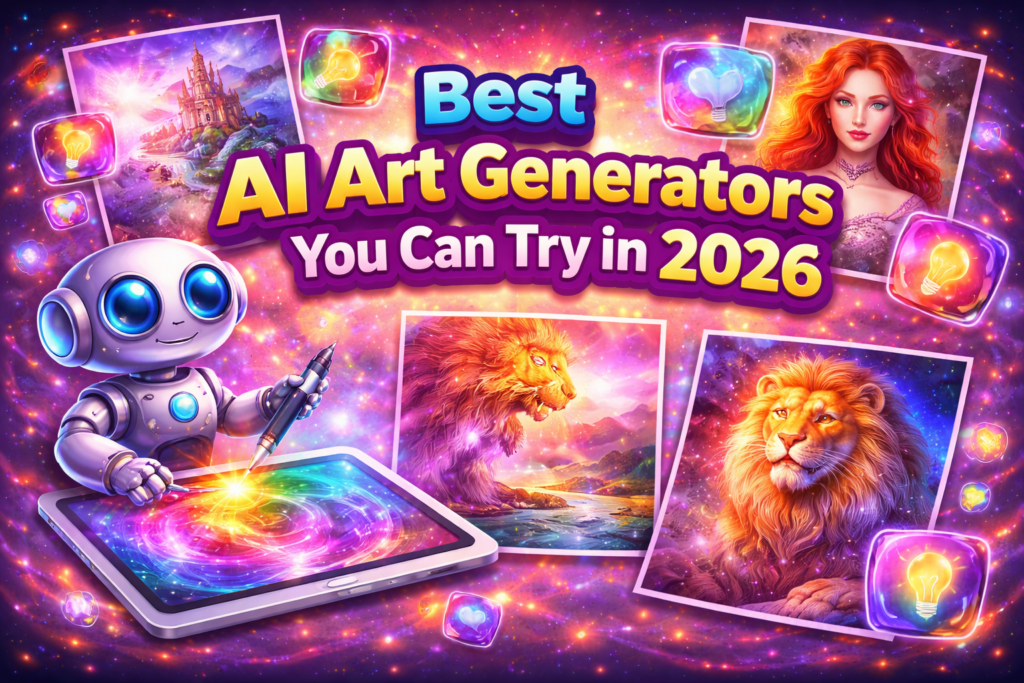
Get a whole look at the changing landscape of AI-generated imagery-from photorealism to surreal arts.
With AI working at such a fast pace, digital creativity is facing many changes, putting almost exquisite visuals at the fingertips of all with a mere text command.
Whether you are a graphic artist, marketer, content creator, or just someone who likes to dabble in digital art, AI art generators are the new language of art making in 2026.
We are taking you into the best AI image generator tools of this year and will do the necessary comparison, use cases, and features to let you decide what fits best in your life.
From those shining in photorealism to those bursting with imagination, we look at which AI art generator fits better for different user profiles and their creative goal. If you’re wondering which is the best AI art generator for your needs, this breakdown will help guide your decision.
ALSO READ: The Best AI Photo Editors of 2026: Smarter, Faster, and Made for Creatives
Why AI Art Generators Are Booming in 2025
A year is a milestone for digital creativity. Creative people, marketers, educators, and just about everyone out there use AI these days to extend their creative powers. Yet why has there really been this push?
First, the accessibility. People do not require technical knowledge or a hefty lump of cash for expensive software to create top-notch visuals. AI art generators now come with GUI-based interfaces that are free or near-free, thus widening the art domain for everyone.
Second, the outputs look fantastic-everything that DALL·E 3 and Midjourney says: to be able to generate pictures from an artistically typed prompt that ranges from photorealistic to highly stylized, along with fidelity and styles that can be considered just as much an item through a traditional way, if not bit immediately through fast and high scale.
Third, the demand for personalized content becomes so big, almost every industry now renews its walls into transformation: marketing, eLearning, and even the AI-created images are becoming visual solutions that are morphing how businesses and personal activities realize content.
In 2025, AI-generated art is not just a trend; it’s a staple in the digital creative process. What once required a designer or illustrator can now be done in seconds with tools that harness the power of generative AI certification standards and deep learning models.
Additionally, advances in multi-modal AI have enabled greater control over artistic direction, color palettes, and composition. Users can combine text prompts with sketches or images, guiding the AI to deliver exactly what they envision.
Finally, copyright concerns and legal indemnity have evolved. Major platforms are addressing these challenges by using licensed training data, giving users peace of mind when using their AI-generated content for commercial purposes.
With so many platforms offering unique features and strengths, knowing which AI art generator is best for beginners or advanced users alike becomes essential to maximizing creative impact
Key Features to Look for in an AI Art Generator
Before we jump into the rankings, here’s what sets the top AI art generator tools apart in 2025:
- Style Versatility: Ability to produce different art styles (photorealism, anime, surrealism, 3D, etc.)
- User Interface: Is it beginner-friendly, or geared toward seasoned designers?
- Customization: Can you refine prompts and tweak outputs?
- Editing Features: Does it offer image enhancement, layers, or inpainting tools?
- Pricing Model: Free, pay-per-use, or subscription?
- Legal Use: Does it provide IP clarity or commercial usage rights?
1. Stable Diffusion: Best Overall AI Art Generator
- Rating: 4.5/5
- Strength: Versatility in styles, high-quality outputs, great for developers and creatives alike
- Price: Free with open-source options; Paid plans from $20/month
While evolving to be truly a powerhouse in 2025, Stable Diffusion has become a versatile tool for the average user or for experienced artists and creators.
With third-party integrations, it was providing support to plugins doing upscaling, inpainting, and fine-tuning of the model. Stable Diffusion is a tool due to the control and creativity of a person to control and create, whether making hyper-realistic portraits or very abstract designs.
“Stable Diffusion is like the Photoshop of AI art: powerful, adaptable, and open for everyone.”
2. Canva: Best for Social Media and Marketing Graphics
- Rating: 4.4/5
- Strength: Ease of use, real-time editing, great for templates and branded content
- Price: $15/month; Free tier available
Imagine all the fun possibilities the built-in AI art generator in Canva opens for the marketers, social media managers, and school educators!
Since it is easy to use and works well with other Canva features, you can now convert AI-generated visuals into professional presentations, infographics, or Instagram carousels.
3. DALL·E 3 (OpenAI): Best for Photorealism and Prompt Precision
- Rating: 4.4/5
- Strength: High-fidelity, photorealistic outputs with prompt-guided refinement
- Price: Integrated with ChatGPT Pro; $0.04 per image
If photorealism is your niche, DALL·E 3 remains a strong contender.
Due to its competent text-prompt apprehension and strong output resolution, DALL·E is good in the e-commerce visuals, marketing banners, and editorial design departments.
4. starryai: Best for Artistic Style Exploration
- Rating: 4.4/5
- Strength: Artistic style variety, strong community templates
- Price: Free up to 25 images/day; Premium starts at $15/month
Starryai shines when it comes to expressive, stylized outputs. If you love experimenting with brush strokes, surrealism, or anime aesthetics, this platform is ideal.
It’s especially beginner-friendly, making it a good answer to which AI art generator is best for beginners and also one of the top options if you’re wondering which is the best AI art generator for style customization.
5. Midjourney: Best for Surreal and Fantasy Creations
- Rating: 4.1/5
- Strength: Imaginative flair, vibrant color palettes, community support
- Price: From $10/month; No free tier
Midjourney produces images that feel alive with mood and emotion. From sci-fi book covers to fantasy character design, it’s a dream tool for illustrators and concept artists.
While it does have a steeper learning curve via Discord, the results are often breathtaking.
“Midjourney isn’t just a tool, it’s a playground for the imagination.”
6. Leap AI: Great for Prototyping and Rapid Ideation
- Rating: 3.8/5
- Strength: Best suited for internal design teams and personalized content
- Price: $99/month
Leap AI is built for fast-moving creative departments. It offers APIs for developers and detailed control for brand consistency.
If you’re scaling content production in-house, Leap AI offers unique enterprise-grade benefits.
7. Prodia: Best for Content Libraries and Variations
- Rating: 3.4/5
- Strength: Reliable bulk generation, ideal for content calendars
- Price: $5/month; Free version available
Prodia isn’t flashy but is incredibly functional. It’s a solid pick for teams needing to generate large sets of content quickly. Best for bloggers, agencies, and small business owners.
8. Jasper Art: Best for AI Marketing Creatives
- Rating: 3.3/5
- Strength: Seamless integration with AI copywriting, brand tone matching
- Price: $49/month
As part of Jasper’s larger AI suite, Jasper Art is built for marketers. It offers brand-matching visuals generated right next to your ad copy or social caption, making it efficient and brand-consistent.
What About Free AI Art Tools?
Not everybody is ready to pay upfront for trying AI art-headed experiments. Fortunately, one has no need to.
Some platforms offer free tiers that are quite generous, so anyone can conjure up eye-catching visuals, images, and art without touching their wallets. starryai, for instance, offers about 25 free images generated per day, while Canva embeds a strong AI art feature in its free design suite.
Even Stable Diffusion is made open source via different front-ends, proving popular with hobbyists and developers alike.
Such freeware is just right for beginners who want to dabble in AI creativity, students looking into digital art, or professionals trying before they purchase.
- Craiyon (formerly DALL·E mini): Great for casual users
- NightCafe: Offers credits, has good community art features
- Starryai: Free up to 25 daily generations
- Dream by Wombo: Mobile-friendly with fun output
These free tools are perfect for testing your creative boundaries without a financial commitment.
User Experience: What Beginners Should Know
Choosing which AI art generator is best for beginners depends on what you value most:
- Ease of Use: Canva, Starryai, NightCafe
- Detailed Control: Midjourney, Stable Diffusion
- Platform Integration: Canva, Jasper, Adobe Firefly
- Community Support: Midjourney, NightCafe
If you’re starting your journey in generative design, consider exploring a generative AI certification to deepen your understanding of prompt engineering, ethics, and creative workflows.
AI Art and Intellectual Property: What You Need to Know
With great power comes great responsibility. As AI art becomes more mainstream, legal questions around ownership and use rights remain under scrutiny.
- Shutterstock & Getty offer indemnified content generated through proprietary models.
- Open-source models often allow commercial use, but always check licenses.
- Originality debates still rage over whether AI art can be “true” art.
For professionals, understanding the licensing of your AI image generator is critical.
Future Trends in AI Art Creation
The AI image generator landscape is evolving rapidly:
- Multi-modal platforms like Adobe Firefly and Google Images are pushing the boundaries.
- Voice-to-image and gesture-controlled generation are emerging.
- Collaborative storytelling through AI visuals is trending in gaming and media.
As tools become more intuitive, the question won’t be “what can AI create?” but rather “what will you imagine next?”
The Creative Future is AI-Powered
With AI art generators gaining sophistication, accessibility, and easy-to-use nature, they no longer merely support human creativity; they accentuate it.
Be it designers, marketers, teachers, or hobbyists, the discrimination of methods has gone, and with it, barriers were lifted from an entirely new avenue of visual storytelling. A method that required years of artistic training no more exists; today, it takes a single well-written prompt.